Architectural Rendering for Design Communication
2 April 2026
The gap between what an architect intends and what a planning officer, client, or contractor understands is one of the oldest and most expensive problems in the built environment. Architectural rendering is the most direct tool available for closing it.
Photorealistic exterior rendering — large-scale urban development in context:

How Architectural Rendering Improves Design Communication Before Planning, Approval, and Construction
Every construction project passes through a phase where a great deal has been decided but very little has been understood — at least not by all the people who need to understand it. The architect has a clear spatial vision. The client or developer has an impression of it, shaped partly by the drawings they have seen and partly by their own imagination. The planning officer has a regulatory reading of it. The contractor has a construction interpretation. All four are working from the same set of documents. None of them is picturing quite the same building.
This is not a failure of professionalism. It is a predictable consequence of using technical documentation — drawings designed for builders and engineers — as the primary tool for communicating with an audience that includes non-technical stakeholders at every level. The result is the kind of misalignment that produces late revisions, approval delays, and construction surprises that could have been avoided far earlier in the process.
Architectural rendering addresses this problem at its source. Not as a decorative extra or a sales tool in the first instance, but as a communication instrument that makes design intent legible to every person who needs to evaluate it — regardless of their ability to read a floor plan.
Why Architectural Ideas Are Often Misunderstood Early in a Project
Why drawings and plans are hard for non-technical stakeholders to read
Floor plans and elevations are precise, accurate, and entirely appropriate as technical documents. They communicate structural relationships, dimensions, and construction details to the people who build from them. What they do not communicate — regardless of their quality — is the spatial experience of the finished building. The proportional relationship between rooms, the quality of natural light through a specific window configuration, the visual weight of a façade material at street level: these are the qualities that determine whether a building actually works, and they are essentially invisible in plan view.
A client who approves a set of drawings without fully understanding them is not being negligent. They are being asked to evaluate a three-dimensional spatial proposal using a two-dimensional professional abstraction that was never designed for their frame of reference. That is an unreasonable expectation, and the construction industry has been absorbing the cost of it for decades.
How architects, clients, consultants, and developers see the same proposal differently
Add to this the fact that each stakeholder in a project brings a different set of concerns to the same documentation. An architect reads plans through a trained spatial imagination built over years of practice. A developer reads them through the lens of commercial programme and risk. A planning officer reads them against a policy framework. A facilities manager reads them as an operational brief. Where each of these readings diverges from the others, a misalignment exists — and misalignments rarely surface until they become problems.
Why communication gaps lead to revisions and delays
The cost of a misunderstanding scales with how late it is discovered. A change caught at design review costs a conversation. The same change caught after procurement costs materials. Caught during construction, it may require rework, programme disruption, and the difficult conversations that follow. The pattern is consistent across project types and scales: unclear expectations at the design stage become expensive corrections at the construction stage.
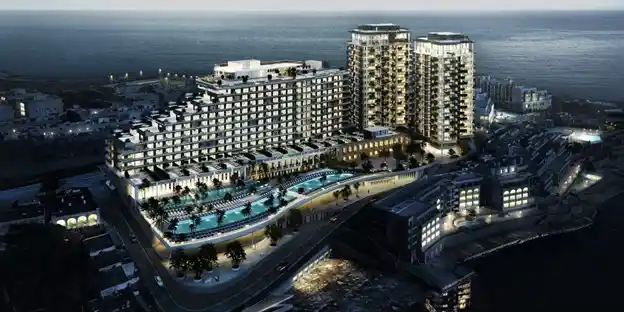
Aerial architectural rendering — hotel complex massing and landscape context:
What Architectural Rendering Adds to the Design Process
Turning design intent into something people can actually see
For many practices, architectural rendering has become the most reliable way to explain design intent to clients and stakeholders before construction begins. A rendered image shows what the drawings specify — the correct materials, the actual proportions, the quality of light — in a form that does not require professional training to read. Crucially, it places the proposed building in its actual context: on its real site, beside its real neighbours, in conditions that approximate how it will actually be experienced.
This is what drawings struggle to do. An elevation shows the face of a building. A rendered street-level view shows how that building will read to someone walking past it at eight in the morning. For projects where public realm, heritage context, or urban fit are significant considerations — and in Glasgow, they frequently are — that distinction matters enormously.
“Rendering does not replace the precision of technical drawings. It completes the communication that drawings begin — translating what a specification accurately describes into something a client, planning officer, or community group can actually evaluate.”
Helping clients and decision-makers approve ideas with more confidence
There is a meaningful difference between an approval given out of trust and an approval given on the basis of genuine understanding. Both look the same in the short term. In the longer term, the second client is considerably less likely to raise objections when the building takes shape on site — because their expectations were formed from accurate visual information rather than projected imagination. Rendering changes the quality of approvals, and that change has direct practical consequences for programme and budget.
Supporting both design review and project presentation
A visualisation produced for client design review does not need to be reproduced for planning submission, public consultation, or investor presentation. The same set of images can support all of these functions simultaneously. For practices involved in the kind of mixed-use and regeneration projects that regularly feature in Glasgow’s architecture calendar, this means that the investment in quality visualisation at the design development stage generates returns across multiple project phases, not just one.
Where Architectural Rendering Fits in the Workflow
Concept stage
Early visualisations are not about photorealistic finish quality — they are about spatial direction. At concept stage, renders can test massing alternatives, explore façade proportions, establish material direction, and communicate the overall character of a proposal before any details have been resolved. These images help architects test whether a concept reads clearly to a non-professional audience, and they help clients engage with a project at the moment when it is still most open to influence.
Design development stage
As the design resolves, rendering becomes more specific. Exterior visualisations show confirmed materials, window proportions, and the relationship between building and context. Interior renderings communicate atmosphere and spatial character — the experience of occupying the space, not just its dimensions. This is the stage at which material and finish decisions are most efficiently confirmed, and at which client feedback has the most leverage over the final outcome.
Projects involving significant heritage or contextual constraints — such as the major civic projects that have shaped Glasgow’s cultural infrastructure — particularly benefit from detailed visualisation at this stage, where the relationship between new and existing fabric is a core design question.
Pre-approval and pre-construction stage
Final pre-approval visualisations serve multiple purposes simultaneously: supporting planning submissions, enabling public consultations, providing contractors with a clear visual brief of expected finish quality, and supporting the investor or pre-leasing presentations that may be running in parallel with the planning process. For commercial developments such as the kind of city-centre office and mixed-use schemes that have defined central Glasgow’s recent evolution, this alignment function is as commercially significant as any design consideration.
Street-level rendering — proposed development seen from pedestrian viewpoint in urban context:

The Decisions That Benefit Most from Visual Communication
Exterior design and urban context
Any decision that involves the relationship between a building and its setting benefits from being evaluated in rendered form. Façade material, window proportion, the treatment of the ground floor relative to the street, the interface between building and public realm — these are judgments that require spatial context to make reliably. Urban context renders, which place the proposed building within a photographic or modelled representation of its actual surroundings, are particularly useful for planning submissions and public consultations where the primary question is how the new development will read in relation to what already exists.
Interior atmosphere and user experience
Interior renderings communicate the experiential qualities of a space in ways that plans cannot. The quality of natural light through a specific window configuration, the visual relationship between ceiling height and floor area, the character of materials in combination — all of these contribute to whether a building actually works for its users, and all of them can be assessed from a well-produced rendered image far more reliably than from a specification sheet or a finish schedule.
Development and real estate presentation
For developers and real estate professionals, the commercial case for architectural rendering is straightforward. A development that can be presented through photorealistic visualisations of the finished spaces before construction begins can be marketed, leased, and financed earlier and more effectively than one that cannot. Architectural animation extends this further still, enabling dynamic walkthroughs and sequential spatial presentations for larger or more complex schemes where static images alone do not capture the full experience of the proposal.
How Architects Use Rendering Without Replacing Drawings
Drawings for precision, renderings for clarity
Architectural rendering and technical drawings are not alternatives to one another. They perform entirely different functions and both remain essential. Drawings are the legal and technical record of a project — they specify dimensions, structural requirements, material standards, and everything a contractor needs to build correctly. Renderings communicate how the finished project will look, feel, and relate to its context. The most effective practices use both: drawings for technical precision with professional collaborators, renderings for visual communication with everyone else.
Why visual communication matters in mixed stakeholder teams
Architecture projects increasingly involve diverse teams — architects, structural engineers, services consultants, planning consultants, heritage advisors, landscape architects, and more. Each brings its own professional language and its own way of reading documentation. Rendered visualisations provide a shared reference point that cuts across disciplinary vocabularies: a common visual language that all members of a project team, and all external stakeholders, can use as a basis for discussion and decision-making.
A Practical Checklist Before Ordering Architectural Renderings
What information should be ready
Prepare before briefing a visualisation team:
- Confirmed plans and elevations at accurate dimensions
- Site information— orientation, neighbouring structures, landscape context, and any photographic reference of the actual site
- Material and finish specifications, or reference images for materials under consideration
- Lighting priorities— natural light conditions and any artificial lighting intent
- Aesthetic references show the design direction and intended character
- Camera angle preferences and any specific views requested by clients or planning authorities
- Intended use— client approval, planning submission, investor presentation, or marketing, which affects resolution and delivery format
When renderings are most useful
Visualisation delivers most value at these project moments:
- Before presenting concept direction to a client or planning authority for the first time
- Before confirming material and finish specifications at design development stage
- Before preparing a planning submission that benefits from clear contextual communication
- Before any major design revision that significantly affects the visual character of the project
- Before launching a marketing or pre-leasing campaign for a commercial development
How to use them well
To get maximum value from architectural visualisations:
- Use renders to compare options side by side rather than presenting a single resolved direction
- Brief all stakeholders on what to look for in each image to generate specific and useful feedback
- Use the same renders as a shared reference document across the project team, updating when significant design changes are made
- Match finish quality to purpose— early concept renders can be loose; planning submission and client approval renders should be photorealistic
- Repurpose approved renders across planning, marketing, and internal alignment rather than commissioning separate imagery for each use
Frequently Asked Questions
What is the difference between architectural rendering and architectural visualization?
The terms are used interchangeably across the industry in most professional contexts. Architectural visualization is the broader category — any visual representation of a proposed design, including drawings, physical models, diagrams, and digital imagery. Architectural rendering typically refers specifically to the production of photorealistic computer-generated images of a building or space before it is constructed. When architects or developers ask for visualization or rendering services, they almost always mean the same thing: photorealistic digital imagery of a proposal.
Can renderings help with planning presentations?
Yes, significantly. Well-produced visualisations help planning officers evaluate how a proposed building will sit in its context, support public consultations by making proposals legible to community stakeholders who do not read technical drawings, and provide a clear visual record of what has been approved. For schemes in sensitive heritage or urban contexts — a common condition across Glasgow’s city centre and inner suburbs — contextual renders that accurately show the proposal alongside existing streetscapes are particularly valuable for both applicants and decision-makers.
Do renderings replace technical drawings?
No, and they are not intended to. Technical drawings and architectural renderings serve different purposes and both remain essential. Drawings specify dimensions, structural requirements, material standards, and construction details that contractors need to build correctly. Renderings communicate how the finished project will look and feel in its setting. A project needs both: drawings for technical precision with professional collaborators, renderings for visual communication with clients, planning authorities, and other stakeholders whose understanding of the project does not depend on reading plans.
At what stage should architects create renderings?
Rendering is most valuable at three main moments: at concept stage, to test whether the proposal communicates well and to establish design direction; at design development stage, when material decisions are being confirmed and client feedback has the most value; and at pre-approval or pre-construction stage, when planning submissions, investor presentations, and final client sign-off require the highest level of visual clarity. The earlier significant decisions can be validated visually, the lower the cost of any adjustments that follow.
Are renderings only useful for large projects?
No. The communication benefits of rendering apply equally to smaller projects. A single-building residential scheme, a modest commercial fit-out, or a small extension all involve design decisions — materials, spatial arrangement, relationship to context — that clients and other stakeholders need to understand before approving. The scale of the project affects the complexity and cost of the rendering brief, but the underlying communication problem that rendering solves is the same at every scale.
Comments on this guide to Why the idea of home captures our imagination article are welcome.
Glasgow Buildings

Key Buildings in Scotland Articles
Historic Glasgow : best Glasgow architecture of the past
Comments / photos for the Why the idea of home captures our imagination advice page welcome.