|

wolfson medical school: images by gavin fraser
Address: Faculty of Medicine, Wolfson Medical School Building, University
Avenue, University of Glasgow, Glasgow
Designer: Reiach and Hall Architects
WOLFSON MEDICAL SCHOOL BUILDING for the UNIVERSITY OF GLASGOW
BCIA BUILDING AWARD 2004
University of Glasgow Wolfson Medical School Building
Reiach and Hall Architects PR Oct 04

wolfson medical school: image by gavin fraser
Do you know that government spending on public buildings has increased
by
60% in 4 years? Do you realise that the public sector is now the single
largest client of the UK construction industry? Are you aware that across
Government total capital budgets now stand at £32.4 billion for
2003/4?
These words from CABE (Commission for Architecture and the Built
Environment) announced this years call for entries to the British
Construction Industry Awards 2004 hosting the Prime Ministers Better
Public Building Awards 2004. The Prime Ministers Award, since its
inception in 1991, underlines the Government's commitment to ensuring
that its building programme delivers a well designed, high quality
environment for the 21st Century.
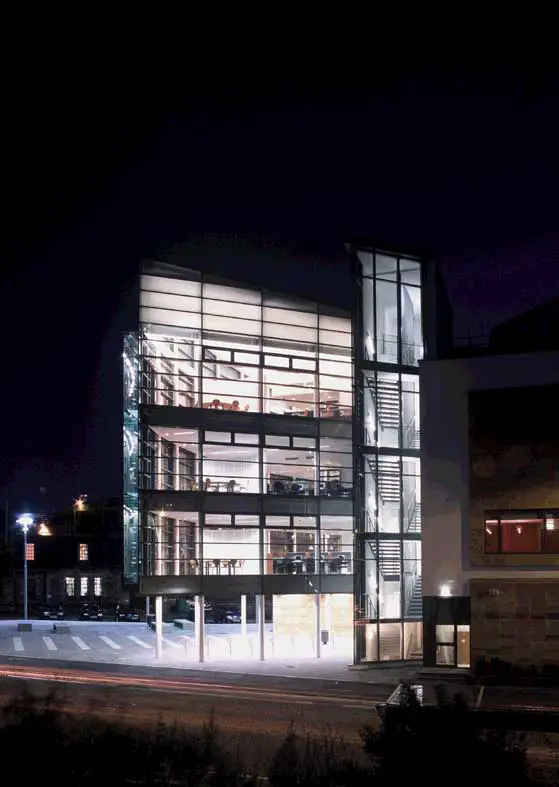
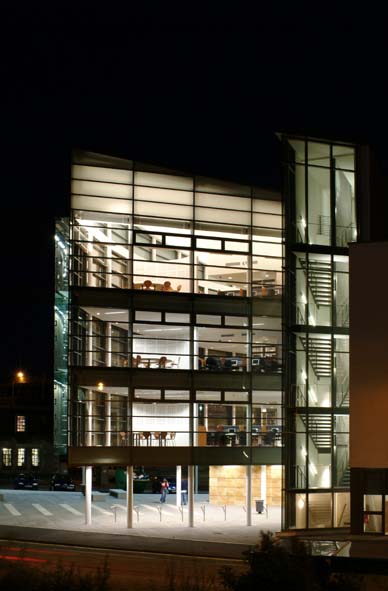
wolfson medical school at night
As one of only two projects in Scotland to win a Civic Trust Award earlier
this year the Wolfson Medical School Building for the University of
Glasgow by Reiach and Hall Architects became the only Scots architectural
project to make it through to the shortlist for this years British
Construction Industrys Building Award and the Prime
Ministers Better
Public Buildings Awards 2004.

wolfson building: image by gavin fraser
Jon Rouse, Chief Executive of CABE (Commission for Architecture and the
Built Environment) said We want to recognise and promote the raft
of new
and exciting public buildings coming through that function well, look
great, and serve the real needs of people living in the surrounding
neighbourhood.
Out of a record 225 entries, the Wolfson Medical School Building yesterday
evening won the British Construction Industrys elite Building
Award
2004. Now in its 17th year the BCIA awards are an industry-wide
scheme
to recognise excellence in the overall design, construction and delivery
of buildings and civil engineering projects.

wolfson building: image by gavin fraser
The Building Award presented by Lord Falconer at the Grosvenor
House
Hotel, Park Lane, London takes the Wolfson Medical School Building to
join
national and international projects credited at the Gala Awards Dinner.
In June the judges visited the building and left saying that The
Wolfson
demonstrates superbly how design for the education sector can be beautiful
as well as functional. It has been created to allow for new methods of
medical teaching, but also to provide a fitting landmark for Glasgow 's
West End in the University's 550th anniversary year.'
Following the Wolfson Medical School Buildings award announcement
the
judges went on to add that the close knit building team are good
friends
after a challenging project and key members have all been reappointed
for
the next phase. The next phase is a new Cancer Research Facility
for the
University of Glasgow and Cancer Research UK at the Universitys
Garscube
Estate which has just recently secured planning permission.

wolfson building: image by gavin fraser
The judges added that the Medical School Building is seen as An
exemplary
facility, nicely built and with a delighted client from the estates
department to the professors. The building is entirely shaped to match
the
Universitys revolutionary teaching method in which students have
to solve
real medical problems in a closely simulated hospital environment.
The
Medical School Building makes excellent use of what in Glasgow is
called
a gusset site - a wedge left at the corner of a diagonal street
intersection. An unpretentious, one off, well considered building
establishing a distinctive landmark for the Medical Schools new
centre of
excellence.

wolfson building: image by gavin fraser
Quite simply, the University of Glasgows Wolfson Medical School
Building
by Reiach and Hall Architects is merited as A model of its kind.
Wolfson Medical School: Building PR 29 Oct 2004
BCIA AWARDS: PRIME MINISTERS AWARDS 2004PR added at base of this
page
Wolfson Medical School: Reiach and Hall Architects
Reiach and Hall Architects' PR
Medical School
Context and Background

wolfson medical school: image by gavin fraser
The fundamental architectural concept of this project of three articulated
blocks arranged around a triangular atrium remains unchanged from the
original design competition winning submission. This concept is generated
by a strong simple organisational (or parti) diagram which responds to
a very specific user brief, Reiach and Halls initial masterplan
strategy for the Western Court site, and the urban landscape of the West
End of Glasgow. Site development strategy proposals are based upon a contemporary
reinterpretation of the original urban grain and building scale prior
to the early 1970s major road re-alignment and demolition works.
Precedents
In parallel with this historical analysis, inspiration to inform the design
direction was drawn from and acknowledges the significance of several
influential existing local precedents examples of which include:
· the collegiate arrangement of quadrangles and inhabited
walls exemplified by the Gilbert Scott main building.
· successful gushett resolution found elsewhere in
Glasgows West End exemplified by the Argyle Street/Sauchiehall Street
junction.
· the West Ends network of lively lanes exemplified
by Ashton Lane
· object buildings sensitive and appropriate to their
surroundings exemplified by the Round Reading Room, which Reiach and Hall
recently refurbished for the University.

wolfson medical school: image by gavin fraser
Spatial Organisation
The design synthesises these and other considerations into a bold but
sympathetic piece of urban planning in which the new Medical School performs
a pivotal role. Within the proposed overall masterplan framework the new
Medical School has a prominent setting at the apex of the triangular gushett
site. Building face alignment is responsive to the existing roads configuration
through a hierarchical series of primary and secondary edges expressed
in rectilinear forms. In contrast, a radial object element acts as a counterpoint.
Four elements accommodate the Medical Schools space requirements:
· learning accommodation with the larger L-shaped block addressing
University Avenue and the new University Quadrangle.
· service or ancillary type accommodation within the smaller L-shaped
block responds to the site indent created by the existing Western Infirmary
pharmacy.
· the triangular atrium court reconciles the conflicting geometries
imposed by the gushett condition and becomes the physical
and social core of the new facility.
· the study landscape/administration accommodation contained within
a curvilinear form becomes the object building or icon for the new Medical
School.
Accommodation
The learning accommodation block re-instates the original urban grain
of this site by forming a primary edge condition to University Avenue
and a secondary edge to the Hortus Medicus quadrangle. All the Seminar,
group tutorial, Clinical Skills and Communication Skills learning areas
are housed within this block along with some academic offices and the
common room.
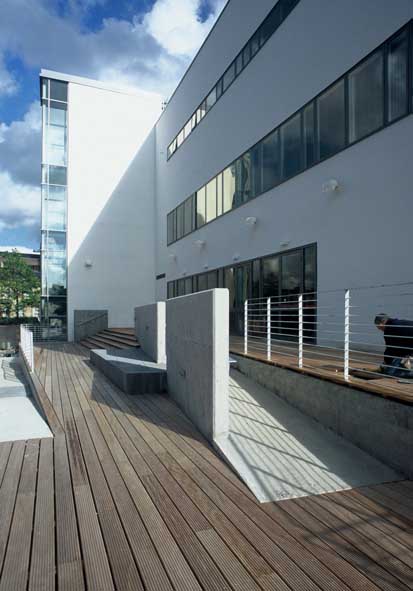
The façade to University Avenue is primarily of natural ashlar
sandstone layered upon smooth white render. In contrast, the façade
to the medical garden is primarily clad in smooth white render with some
sandstone features and slot fenestration.
The service/ancillary accommodation block forms a secondary edge to University
Place and the pharmacy adjacent. Horizontal and vertical services distribution
is concentrated within this block along with lifts, stairs, toilets, stores
and some ancillary rooms (eg. actors and patients room).
Fenestration is kept to a minimum and is expressed by a combination of
vertical and horizontal window and louvre slots. Walls are smooth white
render.
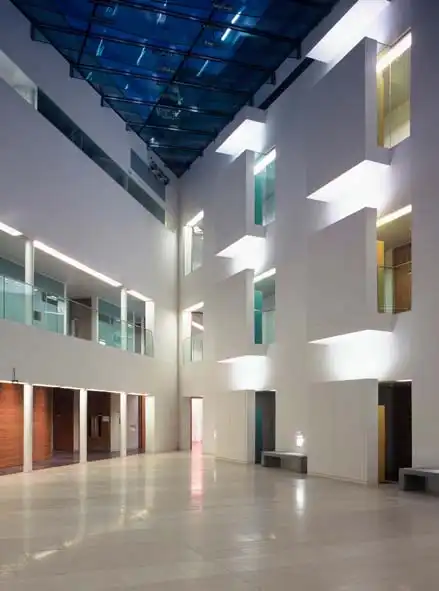
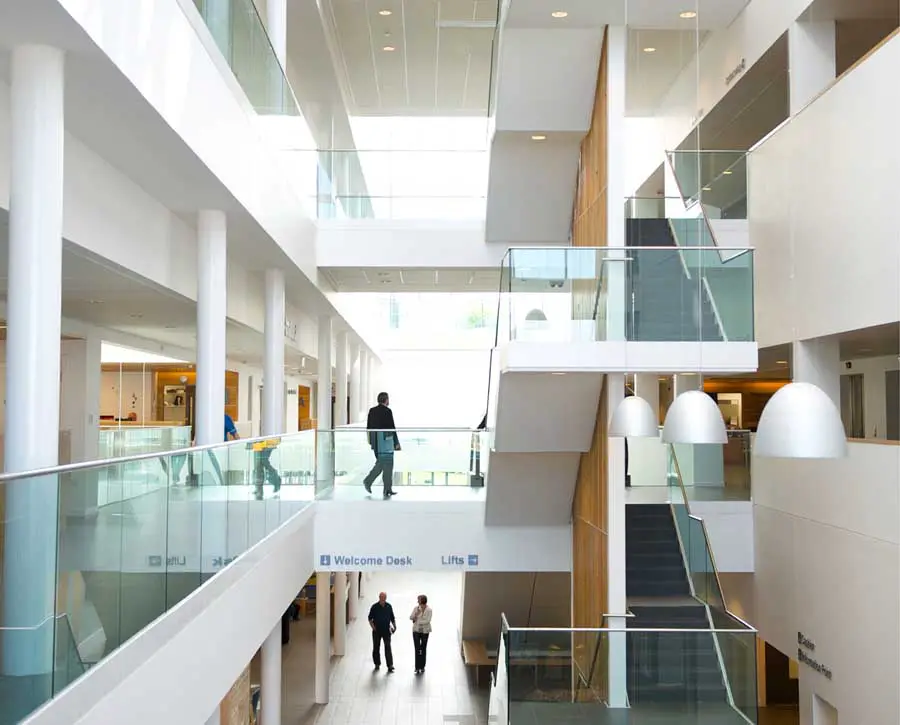
The atrium court is the social and physical heart of the new building.
It is envisaged as a multipurpose space to cater for differing user requirements
eg. informal functions, exhibitions, receptions, student forum etc. This
space is capable of combining in a variety of ways with the common room
and the seminar rooms foyer space dependent on functional requirements.
The circulation zones and accommodation interfaces adjacent to the atrium
vary on each floor.
At ground floor level, a colonnade acts as the interface between occupied
space and the atrium. At first floor level, a glazed balustrade gallery
surrounds the atrium void on two sides. At second floor level, learning
accommodation rooms abut the atrium void. The service core accommodation
on each level is effectively screened by projecting locker banks and informal
seating areas.
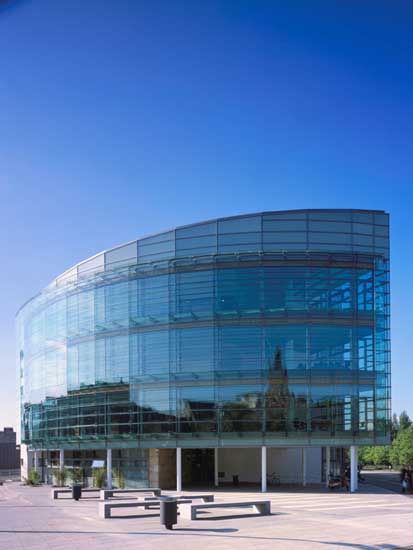
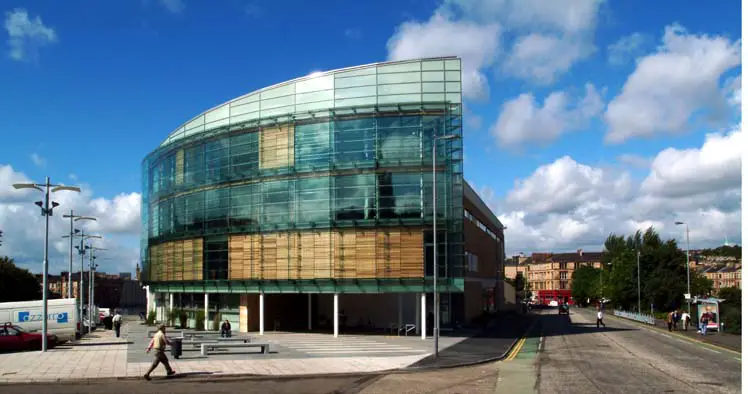
The study landscape curvilinear block acts as a powerful contrasting element
to the rectilinear geometry of the other elements, and is envisaged as
the iconic element for the new Medical School. It is located on the most
prominent location within the available site ie. the apex of the gushett.
The study and resource base accommodation occupies the top three floors
of this block with the Deans Group office accommodation located
on the ground floor adjacent to the main entrance.
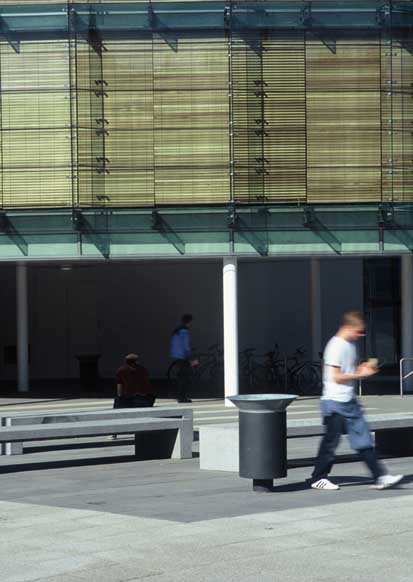
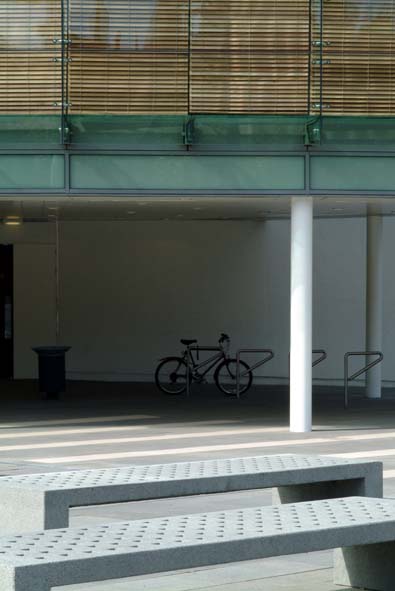
The architectural expression of this element is of a crystalline minimalist
glass envelope with a projecting second glass skin acting as a solar control
device.
Design and Construction Challenges
The use of glass as a primary structural material both for the atrium
roof beams (which have varying spans up to 16m) and the cantilevered outer
skin of the study landscape curved wall has proved to be the most significant
design and construction challenge.
External Spaces
The design philosophy is not restricted to the new building and its inter-relationship
with the city. The landscaped spaces around and between the built forms
are considered to be equally important, and consequently influence the
internal spatial organisation.
Two new public open spaces, each with a distinct character and purpose
are proposed.
Hortus Medicus
The earliest botanic gardens established in Europe were collections of
plants for education in university medical schools. The first botanists
were all practising doctors. The physic garden of the University of Glasgow,
established in 1704 and demolished during the 19th century, was very much
part of the Universitys history. Re-introduction of this tradition
is proposed by providing a contemporary equivalent of the traditional
Hortus Medicus, a garden to demonstrate plants useful in medicine.
Medics Corner
The Medics Corner links the Medical School with the wider urban
fabric. A proposed piece of public art will provide a focal point. Plant
containers, trees and other street furniture will punctuate the plaza.
The Medics Corner will become a central meeting point in the students
university life and, in time, a key landmark along University Avenue.
Contract Timetable
Construction work started on site in October 2000 and completed in August
2002. The contract value is £9m.
Credits
Client: University of Glasgow
Architect: Reiach and Hall Architects
Quantity Surveyor: Turner & Townsend
Structural Engineer: URS Corporation
Façade Engineer Arup Facade Engineering
Specialist Glazing Mag Hansen
Mechanical & Electrical Engineer: Hulley & Kirkwood
Landscape Architect: Gross Max
Planning Supervisor: Beattie Watkinson Planning Supervisors
Contractor: Costain
Wolfson Medical School, Glasgow: Jan 2003
The Wolfson Medical School was one of eight RIBA Award-winning buildings
in Scotland in 2003.
The School opened on University Avenue Autumn 2002:
Reiach and Hall Architects, who won the Wolfson Medical School commission
following a competition in 1999
REIACH AND HALL ARCHITECTS : WOLFSON MEDICAL SCHOOL
for the University of Glasgow
DYNAMIC PLACE AWARDS 2003
Following on from an RIBA award in the summer, the Wolfson Medical
School by Reiach and Hall Architects for the University of Glasgow has
now received a DYNAMIC PLACE AWARD 2003.
The Dynamic Place Awards recognise excellence in the design and implementation
of projects which enhance Scotland's urban and rural environments. Now
in their third year, these awards are an important catalyst towards improving
and promoting the economy and environment of Scotland. This aim is promoted
by the Scottish Enterprise and supported by Communities Scotland, Highlands
& Islands Enterprise and Scottish Natural Heritage
Judges visited the Wolfson Medical School earlier this year. Their credit
notes the Wolfson Medical School as "A superb new building on a highly
visible gushet site. Accommodating new methods of medical teaching the
building was created not only to respond to a detailed brief from the
Medical Faculty but to create a new icon for Glasgow's West End, something
it has undoubtably achieved."
Client: University of Glasgow, Estates & Buildings Office
Architect: Reiach and Hall Architects
Quantity Surveyor: Turner & Townsend
Structural Engineer: URS Corporation
Specialist Façade Engineers: Arup Façade Engineering
Mech & Electrical Engineer: Hulley & Kirkwood
Landscape Architect: Gross Max
Planning Supervisor: Beattie Watkinson Planning Supervisors
Contractor: Costain
REIACH AND HALL ARCHITECTS : BCIA AWARDS : PRIME MINISTERS AWARDS
2004
WOLFSON MEDICAL SCHOOL for the University of Glasgow
BCIA & PRIME MINISTERS BETTER PUBLIC BUILDINGS AWARD SHORTLIST
The Wolfson demonstrates superbly how design for the education sector
can be beautiful as well as functional. It has been created to allow for
new methods of medical teaching, but also to provide a fitting landmark
for Glasgow 's West End in the University's 550th anniversary year.'
Prime Ministers Better Public Buildings Awards 2004
and BCIA judges comments made following their visit to the shortlisted
Wolfson Medical School Building for the University of Glasgow.
As one of only two projects in Scotland to win a Civic Trust Award earlier
this year the Wolfson Medical School Building for the University of Glasgow
has now become the only Scots architectural project to make it through
to the elite shortlist for this years Prime Ministers Better
Public Buildings Awards 2004.
The Prime Ministers Better Public Buildings scheme underlines the
Government's commitment to ensuring that its building programme
delivers a well designed, high quality environment for the 21st Century.
The Prime Ministers Award, since its inception in 1991, is hosted by the
British Construction Industry Awards (BCIA).
Out of a record 225 entries, the Wolfson Medical School Building has also
made the BCIA shortlist for the Building Award. Now in its
17th year the BCIA awards are an industry-wide scheme to recognise
excellence in the overall design, construction and delivery of buildings
and civil engineering projects.
The Building Award takes the Wolfson Medical School Building
to join the Architecture Building for Lincoln University, BP Sunbury Business
Park, City and Islington College Life Long Learning Centre, Raines Court
development in London N16 and the UBS & LSO Music Education Centre
in London EC1 as one of the international projects to go forward and await
the award announcements at the Gala Awards Dinner at the Grosvenor House
Hotel, Park Lane, London W1, on 28 October.
Museum
of Scotland
Scottish
Architects from Scotland through the ages
Historic Glasgow: best glasgow buildings
of the past
Glasgow News : back to index
Wolfson
Medical Building : Civic Trust Awards 2004 Scotland winner
Comments / photos for the Wolfson Medical School Architecture page welcome:
info@glasgowarchitecture.co.uk
Wolfson Medical School Glasgow Building
- page: adrian welch / isabelle lomholt
|