Glasgow Institute of Architects, Winners, Entry Info, Commendations, Forms
GIA Awards 2006 : Information + Images
GIA Awards - Tickets, Venue, Date
GLASGOW INSTITUTE OF ARCHITECTS
2006 GIA Design Awards Winners
COMMENDATIONS
Friary Court, Gorbals : Page and Park
Eastend Sawmills, Glasgow : Nord
JKS Workshops, Clydebank : Gordon Murray + Alan Dunlop Architects
Sandyford East, Parkhead : Studio Kap
The Brae, Rhonehouse, near Castle Douglas : Crallan and Winstanley
44 Westbourne Gardens, Glasgow : ZM Architecture
Sustainability Award
Silverhills Housing, Rosneath : Anderson Bell Christie
Incubator Start Up Units, Alba Campus, West Lothian : Reid Architecture
AWARDS
Maggie's Centre, Highlands : Page and Park Architects
Telford Drive, Edinburgh : Gordon Murray + Alan Dunlop Architects
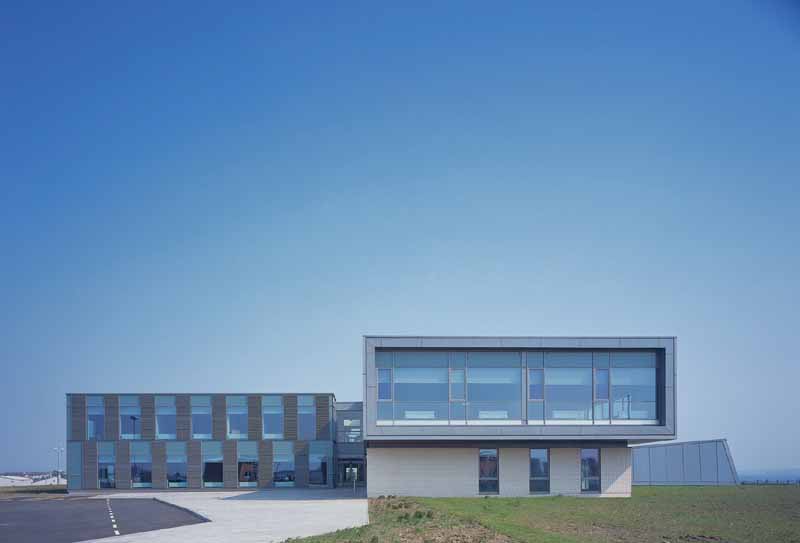
Air Traffic Control Tower, Edinburgh Airport : Reid Architecture
The Wright Business Centre, Glasgow : Elder and Cannon
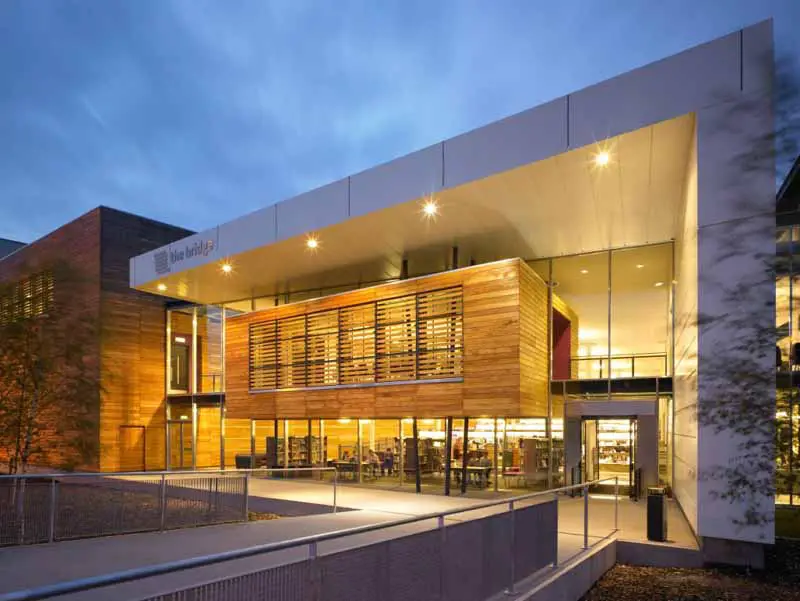
The Bridge Arts Centre, Easterhouse : Gareth Hoskins Architects
Kelvingrove New Century Project, Glasgow : Building Design Partnership
Robin House Children's Hospice, Balloch : Gareth Hoskins Architects
The Saltire Centre, Caledonian University, Glasgow : Building Design Partnership
Oran Mor, Glasgow : ZM Architecture
Domestic Finishing Mill, Anchor Mills, Paisley : James F Stephen Architects
The Holm, Orchardton, Auchencairn : Crallan and Winstanley
Received early Dec 2006
Entries to the 2006 GIA Annual Design Awards are now invited.
The GIA Awards are recognised at a local and national level and are one of the main highlights of the Institute's annual programme. This year it is proposed to increase the size of the touring exhibition in order to permit a larger number of shortlisted entries to be featured.
In addition, this year an award will be made to a project (or projects) drawn from the various categories which the judges consider best exemplifies the ethos of sustainability.
Entries should be delivered to GIA Awards, 27 Ingram Street, Glasgow G1 1HA to arrive no later than Friday 29 September 2006.
The awards will be presented at the Annual Members' Dinner, to be held once again at Oran Mor on Friday 17 November 2006
Float Bay house, Sandhead, nr Stranraer by ARP Lorimer & Associates picture from architect
In 2005 the venue was again Oran Mor, on 11 Nov
GIA Design Awards 2004
Exhibition was at Newton Stewart library and then Stranraer library for the remainder of this month, and then RIAS Gallery for the month of January 2005.
GIA Award Winners and Commendations in 2004:
AWARDS Easterhouse Health Centre by Davis Duncan Architects
12 Broomhill Place, Glasgow by Studio KAP Architects
COMMENDATIONS
Beith Town Centre by Robert Potter and Partners
St. Mungo's, Townhead by Page and Park Architects
Studio/Workshop, St. John's Town of Dalry by Crallan and Winstanley Architects
The Fotheringay Centre, Glasgow by Davis Duncan Architects
GIA ANNUAL DESIGN AWARDS
The GIA Design Awards were the brainchild of the Environment Committee of 1977, who put forward a proposal to Council that GIA should examine the possibility of an annual award for the best new or adapted building in the Chapter area. The Committee were of the firm view that only those buildings which achieved an exceptionally high standard should be considered, setting the criteria that the award would be for examples of “good architecture and buildings, whether new or adapted, which express good design in terms of function and effectiveness as well as aesthetics”. At this early stage, it was agreed that the objective would not necessarily be to find the best building, but to promote public interest in good buildings. This objective survives today, with the promotion and publication of entries to the public at large every bit as important as selecting a winner.
Seven entries were received for the 1978 GIA Award, the outcome of which was that the judging panel ruthlessly dismissed all seven as being insufficiently “excellent” and refused to make an award. Council re-visited the assessment criteria, although in the event retained the requirement of “excellence”, and in 1979 from the twenty entries received, awards were made to six buildings - including King, Main and Ellison’s Scottish Amicable Headquarters on St. Vincent Street. Entries were exhibited in the Design Centre which, until its demise as a viable venue, hosted the GIA Design Awards Exhibition on an annual basis.
In recent years, categories under which buildings can be submitted have been introduced, and from time to time there have been Sponsor’s Awards, a President’s Award and a People’s Choice Award. All these have been as a result of the continuing support and interest of the Chapter practices who enter regularly, and the panels of judges whose enthusiasm for their task has over the years remained undiminished. Critically, also, the Awards Exhibition has gone from strength to strength helping fulfil the original objectives of the initiative as devised twenty-seven years ago.
This year, the criteria that the building had been completed for at least six months was re-introduced and, as a result of this, the number of entries was reduced, although the standard remained exceptionally high. Of the twenty-two entries received, twenty received a note of interest from at least one of the judges and, in the event, visits were made to twelve of these.
This year’s judges were Fiona Sinclair (President of the Glasgow Institute of Architects), Martin McKay (GIA Communications Convenor), Councillor Patricia Chalmers, Liliane McGeoch (President of the Stirling Society of Architects) Ian Gracie of Watson Stonecraft, and Neil Gillespie of Reiach and Hall. Over a two-day period they travelled the length and breadth of the Chapter area and, it has to be said, were until the afternoon of the Awards Dinner still debating the merits of the various buildings viewed.
There were a number of near misses - buildings about which one or even two of the judges felt strongly but which in the event didn’t quite win through. These included the St. Cuthbert’s Street housing in Maybole by Wren Rutherford, Bearsden Baptist Church by Davis Duncan Architects, 200 Broomielaw by Keppie Design, the Icon Building by Elder and Cannon and 27 Whittinghame Drive by Davis Duncan, a building in which the current owner clearly feels a great deal of pride.
After much deliberation, the judges awarded four commendations and two awards. Two of the commendations were made in the Conservation category, where it was felt very strongly that the projects represented much more than simply a job well done. The Cross Regeneration Project in Beith by Robert Potter and Partners used lottery and Historic Scotland funding to recreate something of real townscape value out of a series of buildings which were on the brink of collapse. Although visited in twilight, the judges could still appreciate the very real impact this meticulously detailed project had made to the area, although they had reservations about the appropriateness of the landscaping. Congratulations are due to both architect and contractor for a lovely piece of work which has restored dignity to Beith town centre.
St. Mungo’s Church at Townhead, restored for the Archdiocese of Glasgow by Page and Park Architects, was judged to be a project where careful research and innovative thinking had informed the end result. A model example of sound conservation, the project also employed the sort of lateral thinking which acknowledged the importance of creating a 21st Century interior but with a subtlety which pays due respect to the 19th century church. Furthermore, the craftsmanship was exemplary.
In the Small Works category the judges found a further commendation in the shape of a studio/workshop for Professor Roger Breakwell in St. John's Town of Dalry. Designed by Crallan and Winstanley Architects, and empty at the time of visiting, they could nevertheless visualise this building with its big sliding doors open, the client painting in the studio, and the rest of the family swinging their legs as they relaxed on the deck. They particularly admired the manner in which the restricted budget had been prioritised and enjoyed the care with which the local joiner had assembled the parts.
The final commendation went to the Fotheringay Centre in Glasgow by Davis Duncan. Although there were those of the judges who felt that the impact of the work was slightly diminished by the number of materials used, the restoration of the original church was impeccable, the link block very fine, and the overall composition made a significant contribution to its setting.
This year, GIA gave only two awards - in which the judges were unanimous. The first went to an exquisite house extension in Broomhill by Studio KAP Architects. Built on a tiny budget this kitchen and family room space transformed an otherwise relatively ordinary suburban semi. The client spoke eloquently of her plans for the garden now that it formed part of her actual living space. The judges were impressed by the simplicity of the structure, where the cedar shingle-clad cloakroom and a seating area (affectionately called the bus-shelter) were cantilevered at front and back, by the sparing - yet effective - use of colour, and by the overall standard of detailng. A worthy winner, much loved by the client.
And so, to the final award. The first building visited by the judges, Easterhouse Health Centre by Davis Duncan Architects, simply got better and better the more they talked about it. It was felt that in the first instance, the re-use of two existing buildings and their careful integration as part of a larger whole sent out messages of sustainability and the value of established buildings. Secondly, the stigma created by the distinct functions of the original buildings was at once removed by the new centre, whose screen wall and lovely waiting areas successfully removed any previous associations. Neil Gillespie noted that it had a kind of nostalgic sense of modernism - a white building that is good for you. It had a civic presence, yet managed to be approachable. As Patricia Chalmers noted, an area such as Easterhouse needs to aspire to buildings of this standard. The judges loved it. Many congratulations to the team from Davis Duncan Architects.
GIA Annual Members Dinner
The GIA are now announcing tickets sales for this years GIA dinner, which is to be held in the new West End Venue Oran Mor Glasgow, 375 Great Western Road at Byres Road.
Location: Oran Mor, 375 Great Western Road at Byres Road
Tickets: £40
The function suite at Oran Mor features a ceiling mural by the acclaimed Scottish Author and artist Alasdair Gray. With the quality of the venue combined with a excellent menu this years GIA Annual Members Dinner promises to be an event not to be missed.
This years GIA Awards Main Speaker is Neil Baxter of Neil Baxter Associates who will be well known to many of you. Our chairman of the evening will be announced shortly.
The 2004 Annual GIA Awards will be announced on the evening and the Awards Exhibition will also be on display on the night.
Glasgow Institute of Architects
GIA Awards 2004: DEADLINE EXTENDED to 23 Jul 2004
With the deadline now extended don't miss your opportunity to submit an entry to the 2004 GIA Awards and have your project featured in the forthcoming GIA newsletter. Entries will also be shorlisted to feature in the GIA Annual Awards Exhibition.
In order to include the entries in the newsletter and exhibition submissions require to be in digital format and guidance is given on the attached entry form.
Multiple GIA Awards submissions from practices and individuals will be accepted.
GIA Awards 2007
Venue + Date + Guest speaker + Ticket Booking
The GIA award is the sixth major national and international award for
architecture the practice has won since March 2003.
Early in 2003, the architects were given the 1st European Europa Nostra
Award for their work to Glasgow Central Station, closely followed in May
2003 by the Architecture Grand Prix and the Best Commercial Building Award
at the Scottish Design Awards. In July they were awarded the Special Award
by the Royal Institute of Architects in Ireland for the Radisson and in
October, the award of Best Hotel at the European Hotel Design Awards was
given at a prestigious ceremony in London.
"It has been an excellent year for the practice" says Alan Dunlop " one
where we have gone from strength to strength".
Gordon Murray and Alan Dunlop are on the shortlist to design Glasgow's new
bridge and public realm works, connecting Glasgow's Wall Street with
Tradeston and have always they could compete for major projects from their
base in Glasgow and achieve international recognition without having to
move to London. "This clutch of major architectural awards gives us even
more confidence that this is possible" adds Gordon Murray.
Gordon Murray and Alan Dunlop Architects, Glasgow - 0141 331 2926
2002
GIA Awards Citations
After two evenings shortlisting entries for the GIA Awards 2002, Joan, Irene, Alistair and I took three days to visit all of the projects and get a first-hand impression of the work. As you learn over again when you visit a city or indeed see something built that you have drawn, the reality is always different than the expectation. And I’ll leave it as ambiguous as that.
There were three things that made our journeys so pleasant. The first of course was spending a few days seeing some of the best new work in Scotland. The second was that we readily enjoyed each other’s company. The third thing was a tad unexpected, sadly. Simply, that we met so many thrilled clients, including people who had been introduced, sometimes unexpectedly, to architecture. People whose lives had been enriched, sometimes modestly and sometimes ambitiously.
Mr MacFarlane noted that the family now lived differently, that its centre had gravitated to the rear with its stunning view. The addition to a generic 1950s house is clever in its use of structure and windows to allow a big yet cosy space. On the exterior, it doesn’t attempt to blend in politely but quietly asserts itself. As Alistair said, a contractor’s nightmare that was very well constructed.
AWARD Waddell House by KAP
With the addition the architects reated an enfilade through the existing house with an unashamedly high-art architecture vocabulary of planes and outdoor rooms. There is also clear homage to Le Corbusier, especially in the way colour is used.
AWARD
The Granary in Elie by McKeown Alexander
Anintervention which e accentuates the existing structure and volume, which preserves the feel of being on the top floor of the old granary without resorting to doing as little as possible or creating an unliveable art piece. In fact, it feels as comfortable for family life as for a couple, and we want to know if we can rent it for a weekend.
GIA Awards: Offices
COMMENDATION Scottish Enterprise HQ by BDP
A new concept of office working which the architects translated into an the image of innovation and contentment that the client wanted. And I must say that people there did seem happy. Perhaps most impressive was the massing and the coordination of materials on a difficult site on the river. It is impressively detailed and built.
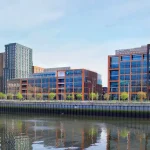
AWARD JP Morgan Chase Building, Murray and Dunlop
It is very difficult to wrest architecture out of a speculative office building in an office park. The architects made a few, simple, strong moves formally and succeeding in making a piece of architecture with a strong identity from the most unpropitious beginnings. A very controlled piece of work.
Leisure/Retail
No Awards Education
No Award GIA Awards: Conservation AWARD
Glasgow New Synagogue, by McKeown Alexander
A few well chosen spots highlight and transform a non-descript hall into something spiritual . The ceiling of the main hall was especially impressive in its use of lighting, in creating a spiritual architecture where there was none. There was a nice consistency of concept in the design, with sharp and economical detailing.
GIA Awards: Small Works COMMENDATION
McGovan House, Bearsden by McKeown Alexander
The economy of thought for a rear addition was very impressive: two big roofs with skylights. The client said that the architects told him to trust them on creating such big volumes and is glad he did.
AWARD
No.1 Dardenne, Kilmacolm by Geoffrey Reid Associates
A well controlled little addition that mediates between the house and the garden. It is nicely proportioned and the varied palette of materials is sensitively detailed.
GIA Awards: Other COMMENDATION
Fieldwork by McKeown Alexander
It is precisely this kind of work, the generation of intellectual property, that architects are doing more and more of and which is slowly being recognised as a service. This is researchthat questions the way one should look at the city and how one could intervention with modest means to achieve large results.
GIA Architecture Awards 2002
The GIA Awards 2002 which were presented at the Annual Dinner on 22 November, held in The Lighthouse.
This was a successful evening which attracted a compliment of 154 members and guests - a full house. The main speakers were Paul Hyett, President RIBA, and Russell Wardrop, Director of Kissing with Confidence.
The remaining top table guests were Gordon Davies, President RIAS, Irene Barkley, President, EAA, who was one of the judges, Professor Steven Spier, Head of Undergraduate Studies at the School of Architecture and Building Science, University of Stratchclyde, who was chairman of the judging panel, Sebastian Tombs, Chief Executive, Hon Secy and Treasurer, RIAS, Dr Stuart McDonald, Director of The Lighthouse, Alistair Wylie, MD of D. Campbell & Co, who was one of the judges, Gordon Reid, Hon Treasurer, GIA, Euan Geddes, Convenor of Communications Committee, GIA.
The Chair for the evening was Joan Scott, President GIA, who was also one of the judges.
25.11.02
Buildings / photos for the GIA Awards Architecture page welcome:
This e-mail address is being protected from spambots. You need JavaScript enabled to view it